Connect your data
CSV, API, webhook, BigQuery, or Google Sheets—pick a source; we normalize timestamps and values.
See what's coming. Act before it arrives.
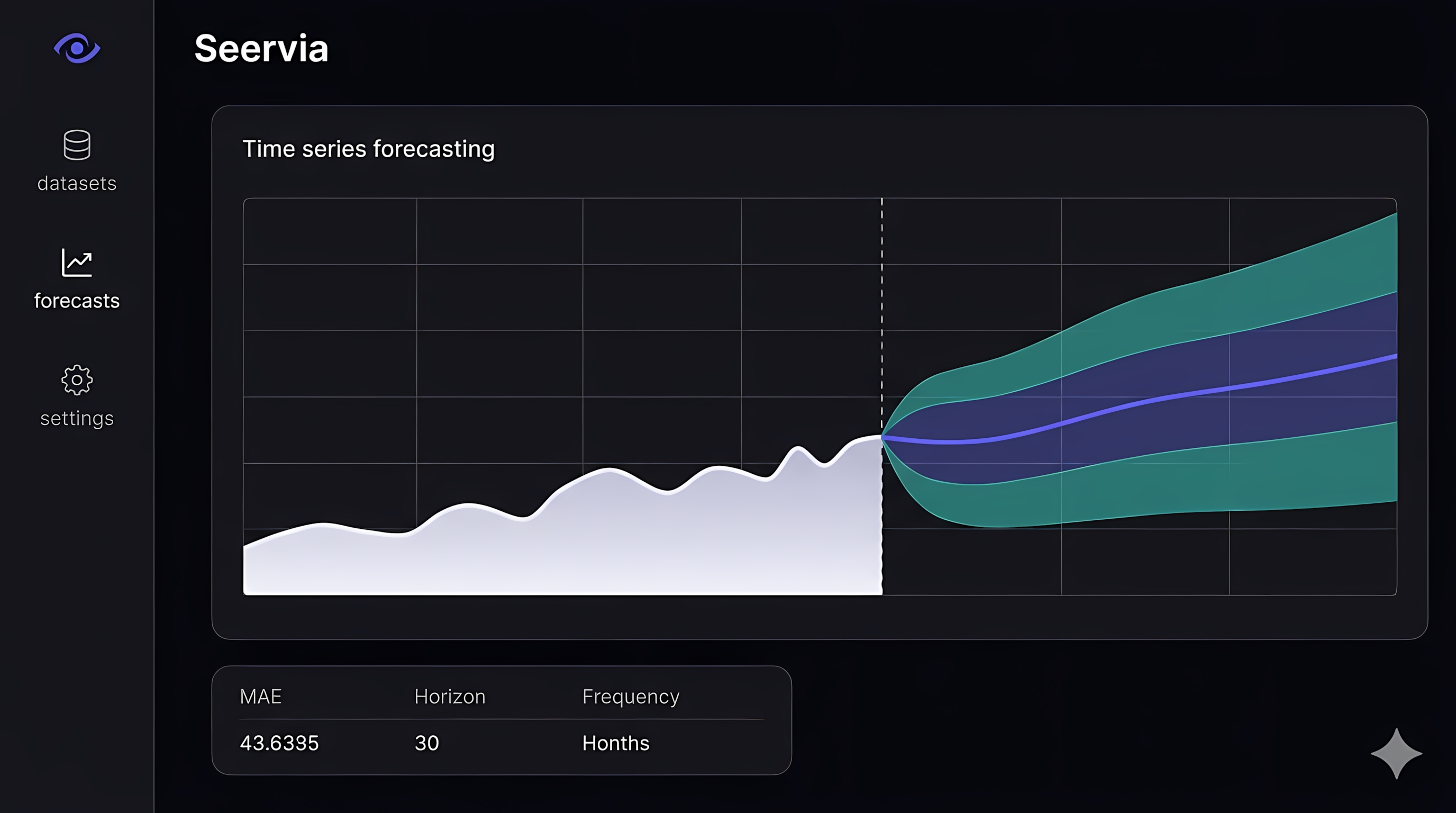
Seervia forecasts any business metric in seconds using zero-shot forecasting with AI—no retraining, no ML team. Connect your data via CSV, REST API, Google Sheets, or BigQuery and get forecasts with confidence intervals ready for production.
Technology validated by Google Research · ICML 2024 · 100B+ training time-points
CSV, API, webhook, BigQuery, or Google Sheets—pick a source; we normalize timestamps and values.
Set how many days or weeks to project and the granularity your ops need.
Get the central path and quantiles ready for ERP, BI, or ops alerts.
Upload CSV via the web console with a guided wizard, or sync Google Sheets so each new row triggers a scheduled forecast—no code or infra to run.
SKU-level demand forecasting to cut stockouts and excess inventory.
Stockouts ↓Volatility, financial KPIs, and business metrics with actionable confidence bands.
Risk ↓Predictive maintenance and sensor signals to anticipate failures and optimize downtime.
Downtime ↓Hospital admissions, epidemiology, and aggregated anonymized biosensor signals.
Stable occupancyElectrical load, variable renewables, and dispatch optimization around peaks.
Marginal costPredictive autoscaling, CPU, memory, and API latency with pre-incident alerts.
Stable p99Environmental variables and precision agriculture with multi-day horizons.
Water ↓DAU, MRR, conversions, and web traffic with scenarios for growth planning.
LTV ↑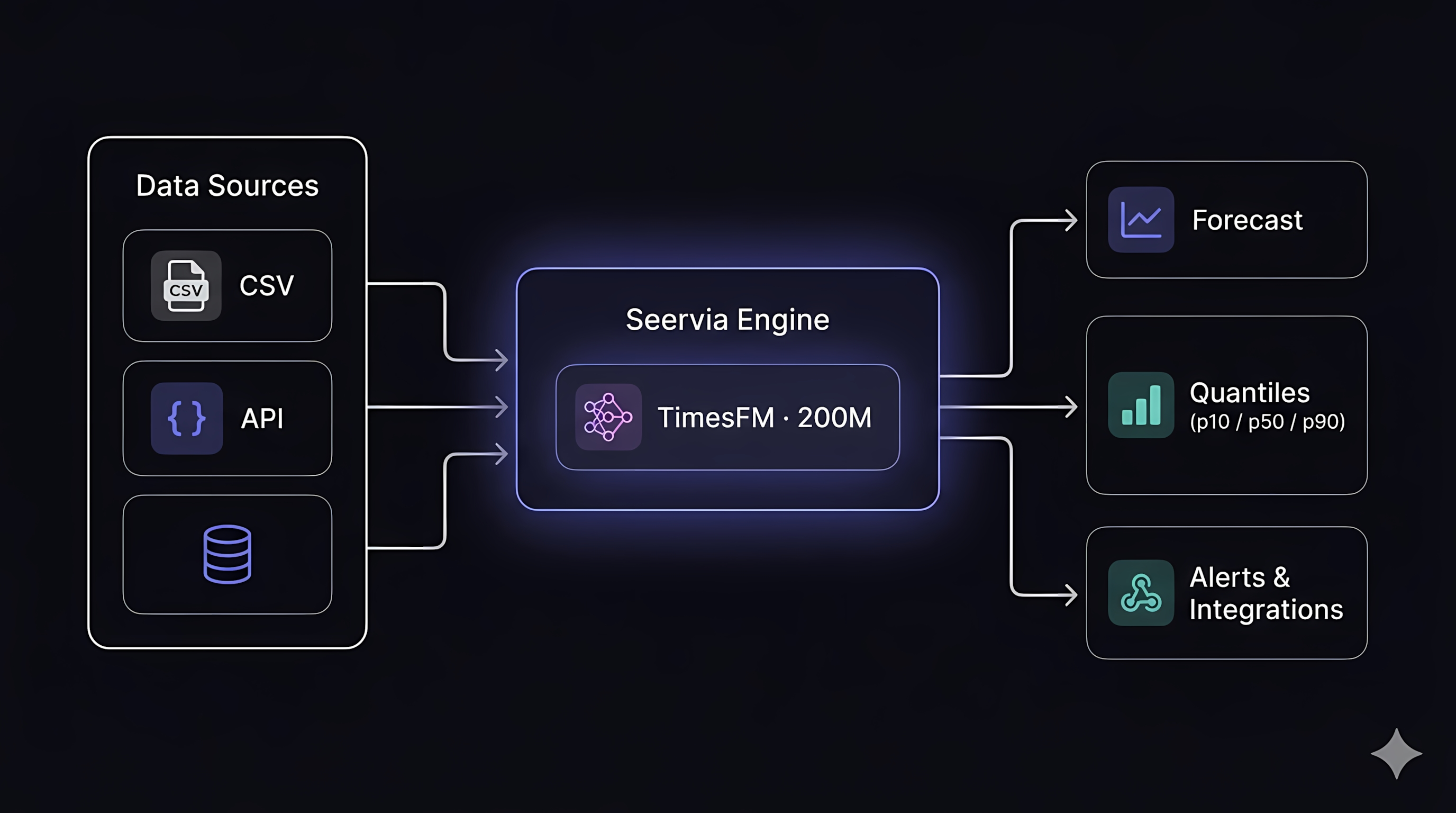
Powered by TimesFM, Google Research's time series forecasting model (ICML 2024), Seervia delivers zero-shot forecasts across any domain: retail, finance, manufacturing, energy, healthcare, and DevOps—with no per-domain training data required.
At inference it runs zero-shot—no new model per customer. The quantile head yields prediction bands without strict Gaussian assumptions, improving decisions under uncertainty.
| Model | MAE ↓ | Notes |
|---|---|---|
| TimesFM | 0.087 | Zero-shot, 200M |
| ARIMA | 0.142 | Per series, manual seasonality |
| DeepAR | 0.118 | Requires training |
| PatchTST | 0.105 | Supervised per domain |
For teams proving zero-shot forecasting value.
$0/mo
Automate forecasts with API and webhooks.
$299/mo
For cloud data and enterprise compliance.
Contact us
All plans include zero-shot forecasting without retraining
Yes. Seervia needs enough history to capture seasonality and trends. In practice, a few hundred points is often enough for useful forecasts, though more history improves robustness. If your data has gaps or regime shifts, segment or clean before sending. Zero-shot removes per-dataset training, not the need for past context.
You can upload CSV from the web, connect Google Sheets, or integrate via REST API and webhooks. Enterprise plans support direct pipelines to BigQuery, Snowflake, and AlloyDB. The minimum format is timestamp plus numeric value; optionally send series IDs to forecast many metrics in parallel. We validate types and time zones on ingest.
Usually seconds after data is available. Latency depends on series size and horizon, but the model runs zero-shot without long training phases. With API integrations, total time is often dominated by data transfer, not inference. For spreadsheets, refresh can be scheduled in minutes or hours.
Yes. The no-code path supports CSV uploads and guided Google Sheets connectors. You can set the horizon and download results without writing code. When you are ready to automate, the same project can scale to the API without switching platforms—ideal for business teams validating value first.
Zero-shot means the model does not need retraining for every new dataset—it generalizes across domains in one forward pass. That cuts cost, speeds time-to-value, and reduces ML headcount per new metric. TimesFM was trained at scale for this. Seervia exposes it as a managed service.
ARIMA and Prophet often need per-series tuning and strong assumptions. Seervia uses a modern transformer with patch tokenization and a quantile head, achieving strong average results on public benchmarks and richer nonlinear patterns without a per-customer training cycle. The trade-off is maintenance burden versus accuracy.
Beyond the point forecast, Seervia returns quantiles forming uncertainty bands. Use them for inventory, working capital, or capacity planning across pessimistic, base, and optimistic scenarios. Quantiles come straight from the model, consistent with TimesFM. You communicate risk to leadership without ad hoc spreadsheets.
Seervia follows B2B security practices: encryption in transit, workspace access controls, and Enterprise options for data residency and custom agreements. Minimize personal data by sending aggregated series. Enterprise includes legal review paths and dedicated support for regulatory needs.
Yes—on Enterprise we enable managed connectors and SQL/ETL-style patterns to read series in BigQuery, Snowflake, or AlloyDB with centralized governance. Solutions engineers design the pipeline with you around refresh windows and agreed SLAs, avoiding repetitive manual exports.
TimesFM is competitive across retail demand, financial metrics, IoT signals, energy load, web traffic, and more. Relative gains depend on data quality and horizon, but zero-shot is designed to work without manual per-industry specialization. We help you measure out-of-sample error in a pilot.
Seervia is built on TimesFM (Google Research, ICML 2024) and delivered as a managed service focused on REST API, quantiles, and connectors (CSV, Google Sheets, BigQuery, and more on Enterprise). TimeGPT and Nixtla are market alternatives with different models, pricing, and workflows; the practical difference is the core engine, B2B governance, and how you measure accuracy on your own data in a pilot.
Yes, as an operational alternative to Prophet- or ARIMA-based stacks when you want less per-series maintenance and stronger averages on heterogeneous benchmarks. Seervia uses a transformer with patch tokenization and a quantile head; Prophet and ARIMA remain valid if you prefer classical models with manual tuning. In a pilot we compare out-of-sample error against your baseline.
Zero-shot removes per-dataset retraining, but it does not replace the need for enough history to capture seasonality and trends. With very few observations forecasts can be unstable; in practice hundreds of points are usually needed for robust results. If your series is short, we evaluate in a pilot and adjust horizon and granularity.
You can consume forecasts via REST API and webhooks to orchestrate jobs from your stack, or export from CSV/Google Sheets into your BI. On Enterprise we enable pipelines to warehouses (BigQuery, Snowflake, AlloyDB) and ETL-style patterns to feed dashboards or the ERP without manual copy-paste.
On public benchmarks, TimesFM achieves competitive MAE versus classical and supervised approaches on average, without training a new model per series. In your business the gap depends on data quality, horizon, and regime; a custom supervised model can win in narrow cases at higher operational cost. We measure out-of-sample error in a pilot to decide with numbers.
Technical and sales teams guide you from pilot to production—in Spanish or English.
We reply within one business day